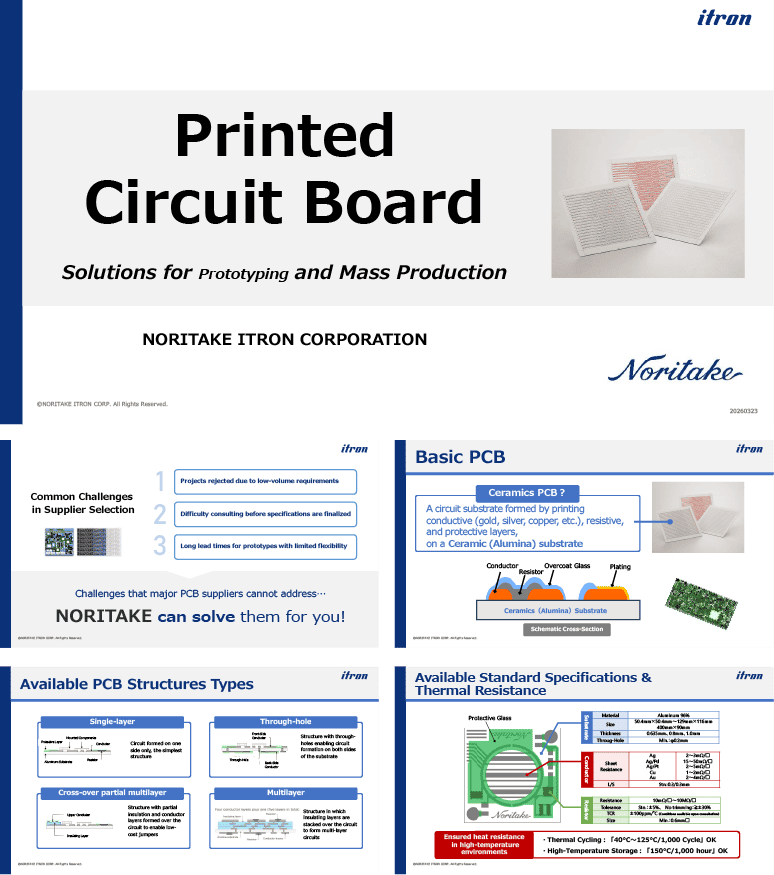


Noritake's Thick Film Circuit Substrates
For applications requiring heat resistance, heat dissipation, and environmental durability. We support projects low- to medium-volume production through mass production.

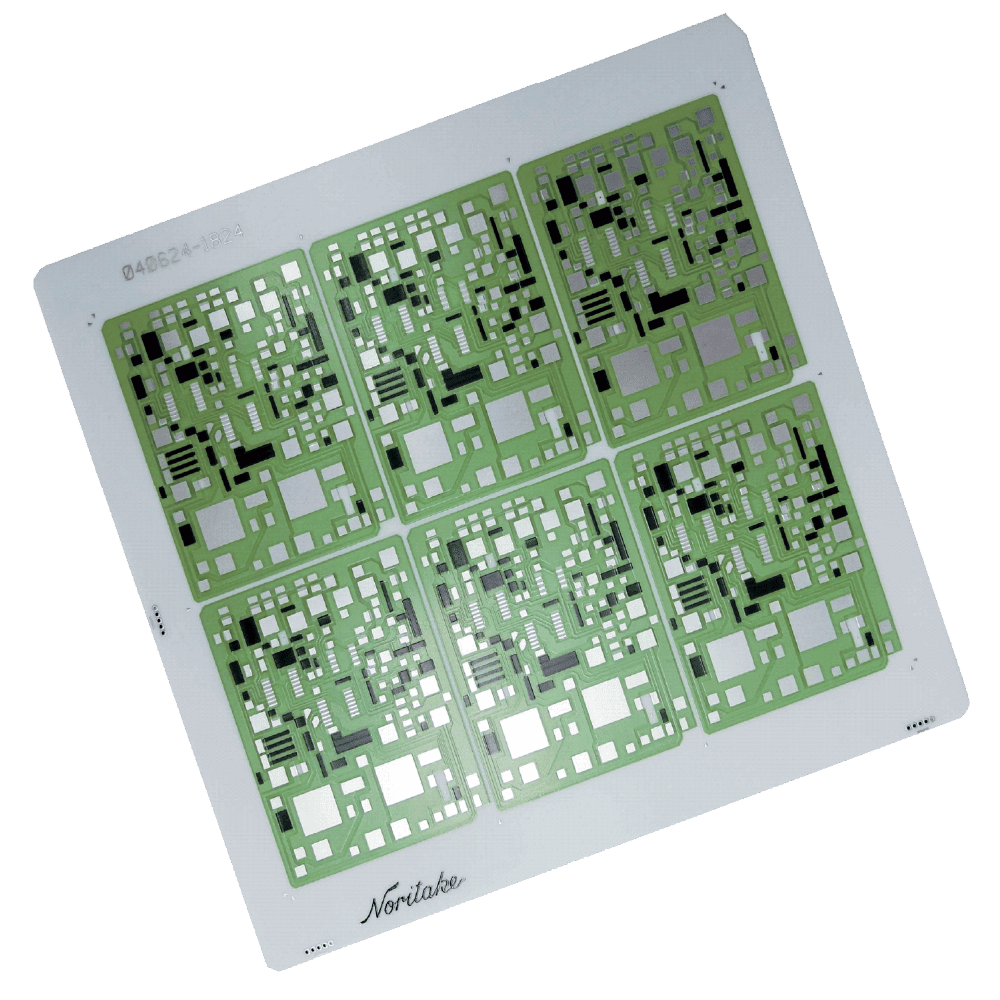
PROBLEMAre you facing any of these challenges with circuit substrates?
You know the operating environment and required performance, but the substrate structure, materials, or prototyping partner have not yet been decided.
-
01

Concerned about the heat resistance of FR-4
-
02

Concerned about moisture, chemicals, or temperature changes
-
03

Unable to find an finding a supplier for small-volume production
-
04

Difficult to consult when specifications are not yet finalized
-
05

Need to plan for mass production after prototyping
ANSWERNoritake's ceramic thick-film circuit substrates can help solve these challenges.
Rely on us for development prototypes through mass production.
Flexible development for prototyping and low- to medium-volume production through mass production.
High reliability adopted for automotive and medical components
WHY NORITAKEWhy Choose Noritake
Thick-film circuit substrates are jointly developed products that require detailed study of performance,
operating environment, quantity, evaluation conditions, and other factors.
Noritake provides consistent support from initial design stage through mass production.
-
01
Supports small-lot prototyping through mass production.
We propose a flexible process from prototyping to production transfer according to your planned quantity.
-
02
Technical support from the design stage
You can consult with us from the early study stage on substrate structure, conductor materials, resistors, and other elements according to the required performance.
-
03
Custom development of electronic pastes
In collaboration with the Noritake Group's electronic paste business, we can also develop custom materials tailored to specific applications.

TECHNOLOGYWhat Are Noritake's Thick Film Circuit Substrates?
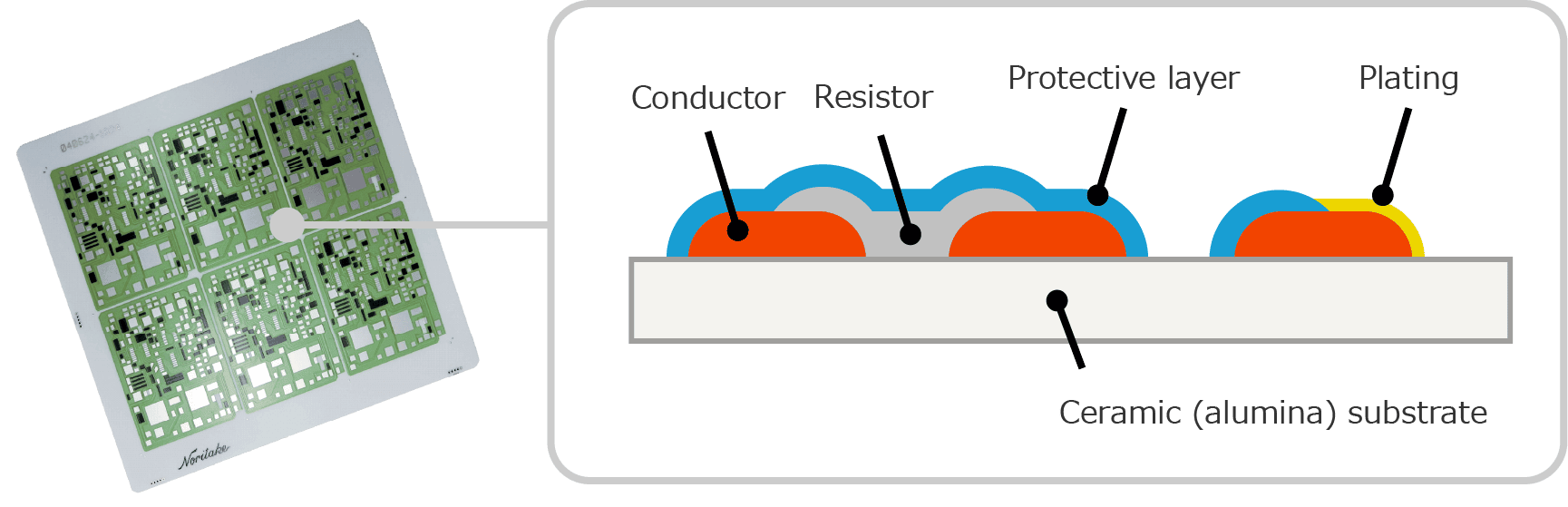
Noritake's thick-film circuit substrates are circuit substrates formed by creating conductors,
resistors, protective layers, and other elements on ceramic substrates.
They are suitable for applications that require heat dissipation, insulation, and heat resistance at the same time.
Benefits of Thick Film Circuit Substrates
-
Heat dissipation
and insulationCeramic substrates are insulating materials themselves and have a structure that facilitates heat dissipation.
-
Resistant to
temperature changesLow thermal expansion enables designs that take temperature cycling into account.
-
Excellent
environmental durabilityThey are suitable for applications that require resistance to moisture, chemicals, and high-temperature environments.

-
Low noise
Low-loss signal characteristics make them well suited for high-frequency circuits and areas around sensors.

COMPARISONDifferences Between Ceramic Substrates and Other Substrates
FR-4 substrates are candidates for general environments, and aluminum substrates are candidates when heat dissipation is emphasized.
However, when heat resistance, heat dissipation, insulation, and environmental durability are all important, ceramic thick-film circuit substrates become the primary candidate.
|
For applications that require heat resistance, insulation, environmental durability, and long-term reliability at the same time. |
For electronic circuits in general environments where cost is a priority. |
For relatively simple circuit structures where high-temperature performance is a priority. |
|
| Ceramic substrate (96% alumina)  |
FR-4 substrate (glass epoxy)  |
Aluminum substrate (aluminum base)  |
|
|---|---|---|---|

Thermal conductivity |
Approx. 23W/(m・K) The substrate itself serves as a heat sink. |
Approx. 0.3W/(m・K) Poor heat dissipation |
Approx. 2W/(m・K) Weak thermal conduction due to the insulating layer |

Coefficient of thermal expansion |
Approx. 8×10⁻⁶/℃ Low expansion and less prone to failure |
Approx. 14×10-6/℃ Risk of solder cracking |
Approx. 24×10-6/℃ Significantly affected by metal expansion |

Flexural strength |
Approx. 400MPa Very hard |
Approx. 540MPa Flexible, but low in strength |
The base metal is strong, but prone to delamination. |

Continuous operating temperature |
Excellent Excellent thermal resistance |
Not suitable Risk of carbonization |
Not suitable Degradation of dielectric layer |

Dielectric tangent |
Excellent Extremely low loss |
Not suitable High loss |
Not suitable Depends on the insulating layer |

Excellent resistance to deterioration |
Excellent Excellent resistance to deterioration |
Not suitable Weak against moisture and chemicals |
Not suitable Concerns about aging degradation and corrosion |
STRUCTURE & SPECSSubstrate Structures and Standard Specifications Available for Prototyping
and Production
We support single-layer, through-hole, crossover, and multilayer structures according to the circuit.
Based on standard specifications, we support substrate design from the prototype stage through production.
Substrate Structures
-
01
Single-layer structure
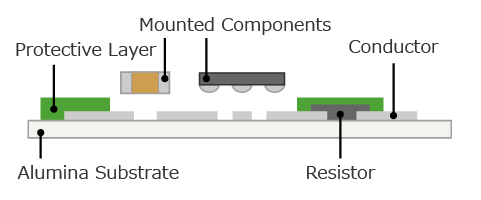
This is the simplest structure, with a thick-film circuit formed on one side of the substrate.
-
02
Crossover structure
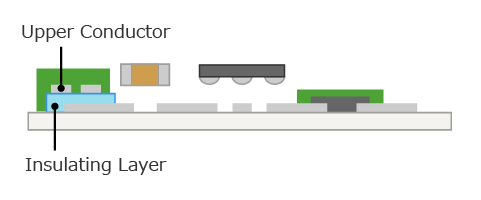
This is a low-cost partial multilayer structure in which jumpers are partially formed using insulating layers and conductors.
-
03
Through-hole structure
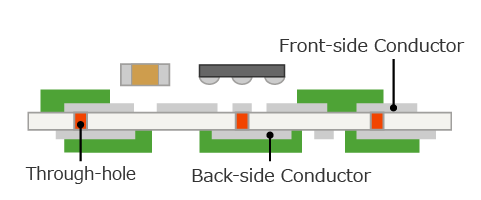
This structure uses through-holes and forms thick-film circuits on both sides of the substrate.
-
04
Multilayer structure
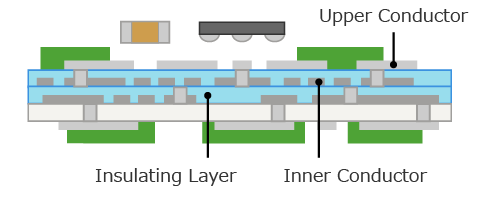
This structure forms multiple multilayer circuits by stacking insulators and conductors.
Standard Specifications (Partial)
-
Substrate
Material: 96% alumina
Dimensions: 50.4 × 50.4 to 129 × 116 mm, etc. -
Conductor
Silver (Ag) resistance: 2 - 3 mΩ
Gold (Au) resistance: 2 - 4 mΩ, etc. -
Resistor
Resistance: 10 mΩ/□ to 10 MΩ/□
Standard tolerance: ±5%, etc. -
Protective layer
Distance from glass to substrate edge: +-0.2 mm, etc.

APPLICATIONS Applications and Adoption Examples
They are used in fields requiring high reliability, such as automotive, medical, and industrial equipment applications.
-
 Automotive
Reliability in high-temperature, vibration, and long-term operating environments

Various sensors, LEDs, and hybrid ICs
Ceramic substrates are selected for automotive environments exposed to heat and vibration because they can maintain stable circuit characteristics.
-
 Medical
Dimensional stability and long-term reliability supporting sensor accuracy

Medical pressure sensors
Highly reliable ceramic substrates with low deformation are used in high-precision medical sensors./p>
-
 Industrial
Resistance to harsh environments such as heat, chemicals, and moisture
Temperature, flow, and electronic ion sensors, etc.
Environmental durability, insulation, and long-term reliability help industrial equipment operate stably in harsh environments.
CONSULTATION PROCESSProcess from Development to Delivery
We support your project from the early concept stage?not just after specifications have been finalized.
-
STEP 1
Development meeting

We confirm the operating environment, required performance, quantity, and schedule.
-
STEP 2
Prototype delivery

We produce and deliver prototypes according to your requirements.
-
STEP 3
Prototype evaluation

Please evaluate the performance and provide your feedback.
-
STEP 4
Approval

Your approval is required before starting mass production.
-
STEP 5
Production delivery

We deliver based on the production specifications.
FAQFrequently Asked Questions
-
Can we consult with you even if the specifications have not yet been finalized?
Yes. We support you from the early design stage, considering required performance and operating conditions, and supporting discussions on substrate structure, materials, conductors, resistors, and other elements.
-
Can we consult with you for small-lot prototyping only?
Yes. We propose a process tailored to your planned quantity and development status, from development prototyping through medium-volume production.
-
Can you handle dimensions or materials outside the standard specifications?
We are also available to discuss requirements outside standard specifications. After confirming the required specifications and operating environment, we will evaluate feasibility.
-
What information is needed for consultation?
Please provide any information available, such as the operating environment, required performance, expected quantity, size, operating temperature, and substrate materials under consideration.
You can consult with us even if the specifications have not yet been finalized.
Download more detailed documentation here.
When you submit this form, an automatic reply email containing the documentation download link will be sent to you.